Swiss AMLA Advisor Regime and Transparency Register: What Changed on 1 October 2026
NOVEMBER 24, 2026
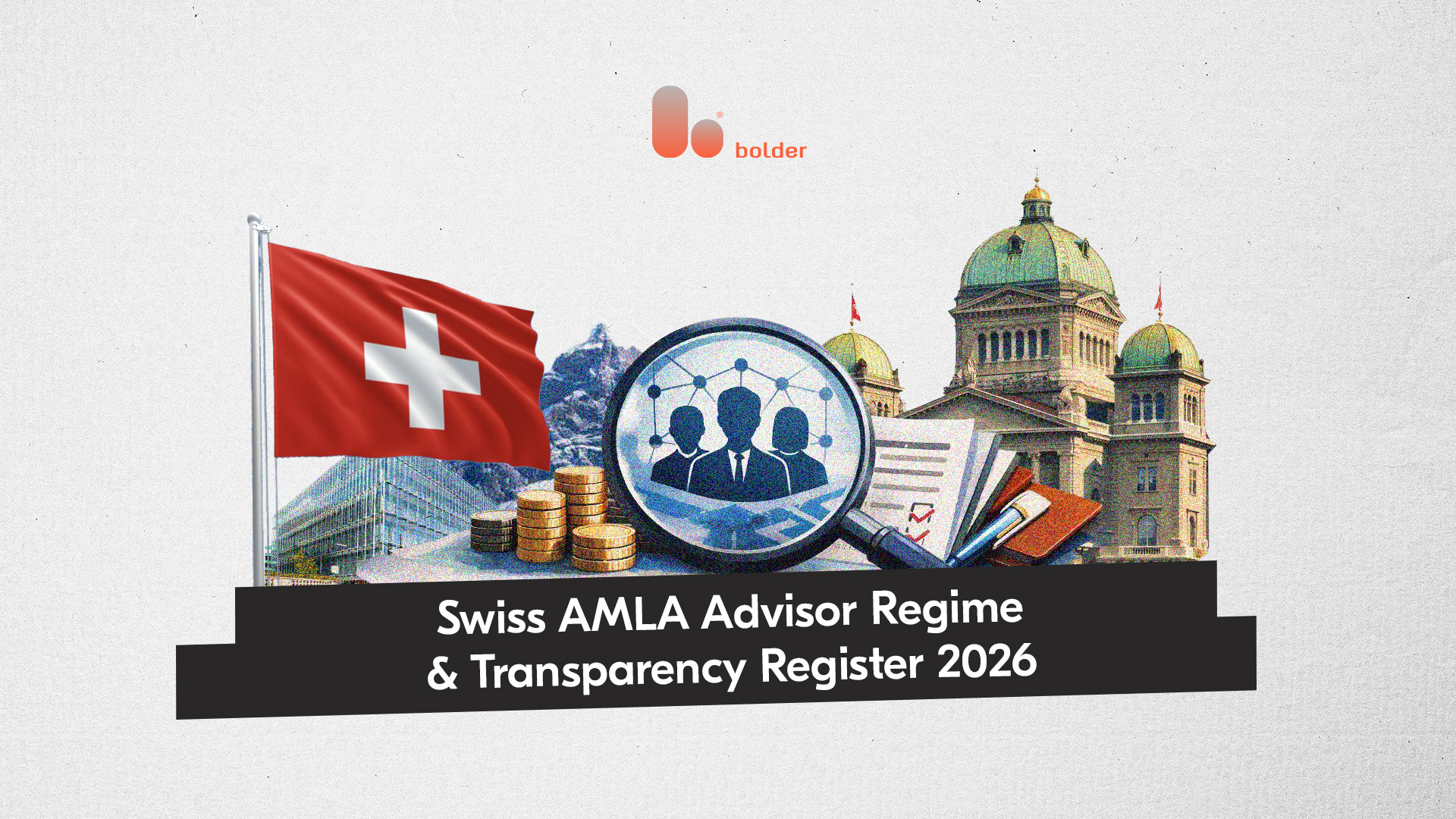
Swiss AMLA Advisor Regime and Transparency Register: What Changed On 1 October 2026
By Carina Santos, Compliance Officer (Bolder Trustees (Switzerland) AG) | Last updated 24 November 2026
On 1 October 2026, two Swiss reforms took effect: a new advisor category under the revised Anti-Money Laundering Act (AMLA) and the Swiss Transparency Register for beneficial owners (UBO). This article explains who must register, the key deadlines, which advisor activities are now covered and what the lighter compliance file involves.
Executive Summary
What changed? Two Swiss reforms took effect on 1 October 2026: the AMLA advisor category and the Swiss Transparency Register for beneficial owners.
Who must register? Unlisted Swiss companies and foreign companies with a Swiss nexus (a registered Swiss branch, effective management in Switzerland or Swiss real property) must report beneficial owners holding 25% or more, or controlling the company by other means.
What are the deadlines? Existing Swiss companies have 3 to 6 months from 1 October 2026 (up to two years if all beneficial owners are already in the commercial register); foreign companies have until 1 April 2027. Changes must be reported within one month.
Which advisor activities are covered? This relates to the second reform, the AMLA advisor regime. It covers six activities, including real-estate transactions, non-operating entity services and domiciliation for more than six months. Where Bolder Trustees (Switzerland) AG (BTS) provides any of these services to a client, BTS treats that client as AML relevant.
What does compliance involve? Under the AMLA advisor regime, BTS treats these clients as AML relevant but only needs to collect a lighter compliance file under Art. 8b, rather than the full file required for other AML-relevant clients.
Swiss Transparency Register
Who must register and report
Unlisted Swiss companies and foreign companies with a Swiss nexus must register and report their beneficial owners (UBO). A UBO is a natural person who holds 25% or more of the company’s capital or votes, or who controls the company by other means.
Deadlines
Existing Swiss companies: the transitional period starts on 1 October 2026 and lasts 3, 4, 5 or 6 months, depending on legal form and audit status. It extends to up to two years if all beneficial owners are already entered into the commercial register (Art. 51 TJPG). The first commercial register change after 1 October 2026 triggers a one-month deadline.
Foreign companies with a Swiss nexus: six months from 1 October 2026, i.e., 1 April 2027 (Art. 53 TJPG). A UID must be obtained first, so start early.
New Swiss companies: within one month of the commercial register entry.
Change of shareholding or control: within one month of the company becoming aware of it (Art. 10 TJPG). A change in holding is reportable only where it crosses a threshold band (25%, 50% or 75%), or control changes in another way.
Swiss companies
Non-listed Swiss companies (AG, GmbH, cooperatives) must register and report their beneficial owners.
Company’s responsibility: the company, normally through its directors, registers itself and reports the UBOs holding 25% or more.
Where an adviser files for the company: the adviser first needs the company’s authorisation to register or report. At a minimum, the company should be informed of its obligation to register and report.
Foreign companies with a Swiss nexus
Foreign companies are covered only with a Swiss nexus: a registered Swiss branch, effective management in Switzerland or Swiss real property.
Registered Swiss branch: the branch is the Swiss nexus for the parent. The parent, not the branch, is registered and reported.
Parent’s responsibility: the parent, normally through its directors, is registered and reports the UBOs holding 25% or more.
Where an adviser files for the parent: the adviser first needs the parent’s authorisation to register or report.
Effective management in Switzerland: the company itself is covered and must also keep a register of its holders (Art. 2 para. 3 in conjunction with Art. 18 TJPG).
Swiss real property: covered if the company owns or is acquiring Swiss real property. A company acquiring property must show proof of its register entry to the land registry when applying for registration (Art. 40 TJPG).
Foreign company: how registration works
A foreign company with a Swiss nexus usually has no Swiss UID number, and one is needed before anything can be filed. Where an adviser or service provider files on the company’s behalf, the process generally runs in this order:
Authorise the filing: the company authorises any adviser acting for it to register and report on its behalf.
Apply for a Swiss UID for the company on EasyGov.swiss (no commercial register entry needed) and register it there.
Power of attorney letter: EasyGov issues a power of attorney letter to the company’s registered office. Authorised persons sign it, and the signed original is scanned and uploaded (photocopies are not accepted).
Identify and verify the UBOs, name a Swiss representative or domicile for service (Art. 17 TJPG) and file.
Trusts and foundations
Foundations are not covered.
Trusts themselves are neither registered nor reported.
If the trust holds a Swiss company, or a foreign company with Swiss nexus, that company must be registered and its beneficial owners reported.
Report the persons behind the trust: the settlor(s), trustee(s) (if corporate, the UBOs of the trust company) and identified beneficiaries. Protector(s) are included where their powers give them control over the trust.
In the standard structure, report the settlor, trustee and identified beneficiaries, with the trust shown in the control chain. Do not automatically extend this to every protector or every member of a discretionary beneficiary class: analyse the trust’s powers first.
No trust roles in EasyGov. EasyGov has no roles such as settlor, trustee, protector or beneficiary. Every person identified behind the trust is reported as a beneficial owner.
Filing authority comes from the Swiss company, not the trustee. A third-party adviser may submit the filing but needs authorisation from the reporting company for EasyGov access. No separate power of attorney from the trust or trustee is required merely to disclose the trust parties.
Information comes from the trustee or client file. The company and its adviser are still expected to obtain reliable information to identify and verify the persons behind the trust, even where the adviser is not the trustee.
If the trustee does not cooperate, the Swiss company must still file. It should use the EasyGov process for an unidentified or unverified beneficial owner and nominate the highest member of the management body as contact person. It should also document its efforts and provide all information it holds.
AMLA Advisor Category
From 1 October 2026, advisors are covered by the AMLA when they provide professional assistance with financial transactions, including fundraising, connected with any of the six activities below (Art. 2 para. 3bis).
Six advisor activity categories
Real-estate purchases and sales
Formation of non-operating Swiss or foreign entities
Management and administration of non-operating entities
Capital contributions and distributions of non-operating entities
Entity purchases and sales through a non-operating entity
Domiciliation for more than six months (registered address or premises, Art. 2 para. 3ter)
Compliance requirements
Advisor clients only need a lighter compliance file under Art. 8b, rather than the full file required for other AML-relevant clients. It covers the following:
Client identity verification
Beneficial owner identification
Purpose of the service
Due diligence records
Further clarification for higher risks
How Can We Help?
For any questions about the new Swiss Transparency Register (UBO register) or the AMLA Advisor category and its compliance implications, please reach out to Bolder Trustees (Switzerland) AG for tailored guidance.
Disclaimer: This article provides general information only and is not legal advice. It reflects the position as at the date below and may change as the law and official guidance develop. Please seek advice on your specific circumstances. Last updated: 24 November 2026.