What Does the Hong Kong-Kazakhstan Hub-to-Hub Model Mean for Investors?
NOVEMBER 16, 2026
What Does the Hong Kong-Kazakhstan Hub-to-Hub Model Mean for Investors?
Executive Summary:
Hong Kong and Kazakhstan are strengthening economic ties across Asia through a hub-to-hub approach.
Kazakhstan's position as Central Asia's largest economy complements Hong Kong's role as a leading global international financial centre.
Improved connectivity between the two financial jurisdictions can encourage more investment and cross-border business opportunities.
Recent discussions at the Global Perspectives on Investment, Wealth and Expansion in Kazakhstan forum in Astana highlighted the growing connections between Benelux, Asia and the Middle East. The event, co-hosted by Bolder Group alongside partners GWM Capital Ltd and Das Family Office, marked a starting point for recognising growth and investment in Kazakhstan, prompting interesting conversations about cross-border structuring and international expansion.
As organisations explore opportunities beyond their traditional markets, strategic financial centres and regional hubs are playing an important role in the promotion of cross-border investment. Hong Kong and Kazakhstan provide an excellent example of a hub-to-hub model within this context. While serving different regions, both jurisdictions encourage access to investment and professional networks, acting as gateways for international business activity.
What Makes Hong Kong and Kazakhstan Complementary Hubs?
Hong Kong has long been recognised as a leading financial centre, providing businesses with access to capital, professional services and markets across Asia. The regulatory environment and strong international connectivity have made it a preferred jurisdiction for companies interested in cross-border investment and expanding into Asia.
Situated in a strategically important location between mainland China, Europe and the wider Eurasian region, Kazakhstan has positioned itself as an emerging gateway for trade and investment across the region. According to the Astana Times, Kazakhstan accounts for nearly 69% of Central Asia’s accumulated foreign direct investment, and there are plans to raise up to $150 billion of foreign investment in the country by 2029. Initiatives such as the Astana International Finance Centre (AIFC) have been designed to enhance the country's appeal as an ideal destination for organisations to expand into.
Kazakhstan is Central Asia's largest economy and already Hong Kong's largest trading partner in the region. Both jurisdictions share a common role in connecting international businesses with new business opportunities. These existing economic ties provide a strong foundation for further collaboration within a hub-to-hub model.
How does the Hub-to-Hub Model Work?
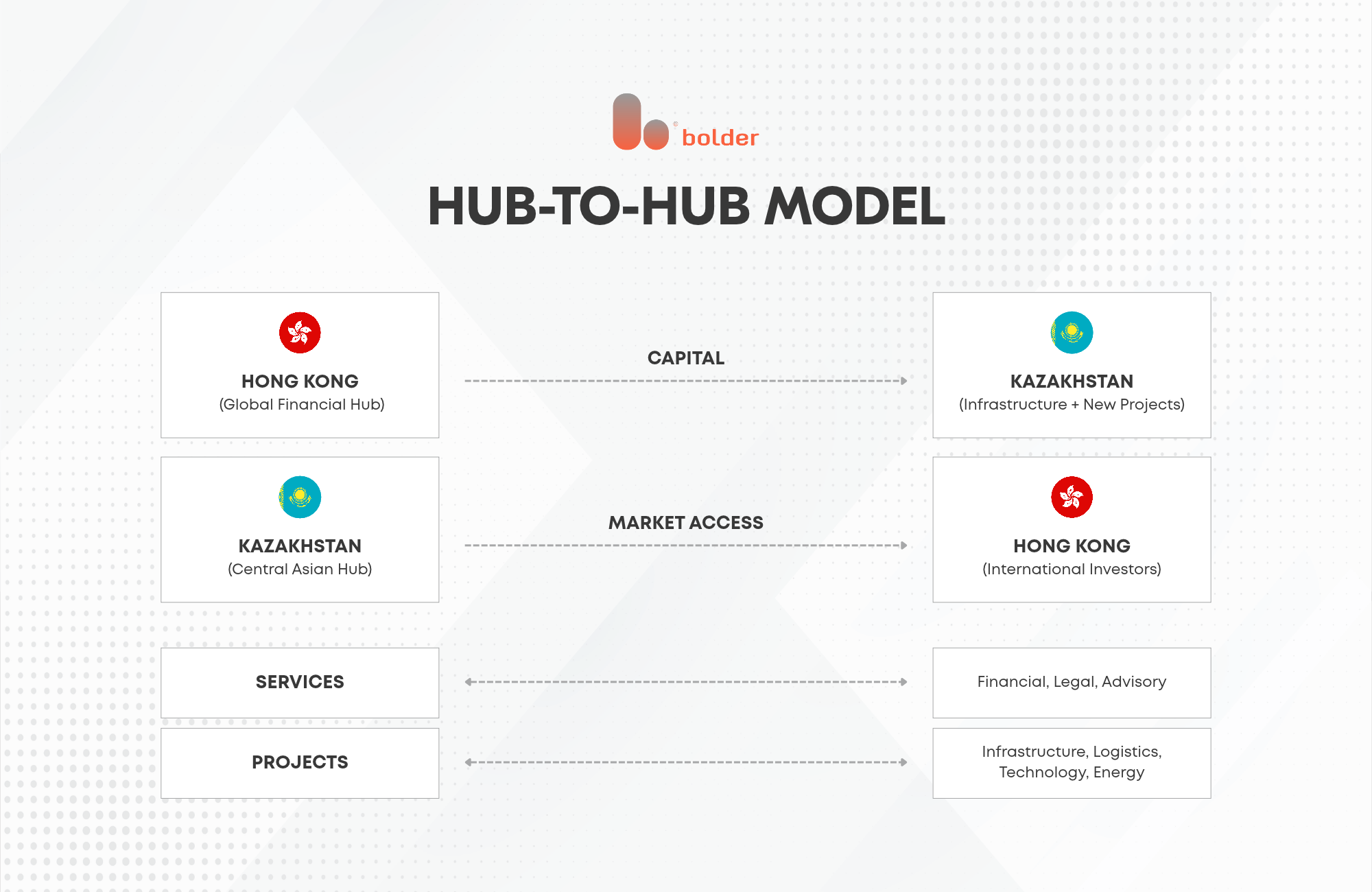
A hub-to-hub model is a strategic partnership between two jurisdictions that decide to connect their economic ecosystems to promote international business and foreign investment.
In this scenario, Hong Kong acts as an active hub for Kazakhstan to explore opportunities across Asia, including Southeast Asia and parts of mainland China. Kazakhstan offers a pathway into the Central Asian market, unlocking regions such as Eastern Europe for investors.
By forming this partnership, both countries can mutually benefit from trading infrastructure, moving capital, and offering professional services across borders. The Hong Kong Exchanges and Clearing (HKEX) and the AIFC signed agreements in June 2026 to link their capital markets, with the announcement of a landmark Memoranda of Understanding (MoUs). Following the announcement, there have been commitments for further investment in the infrastructure connecting the two countries, with Cathay Pacific confirming direct flights starting from the first quarter of 2027.
What Should Investors Consider When Expanding Across Hong Kong and Kazakhstan?
While efforts to improve connectivity between financial hubs will create new opportunities for investment and growth, cross-border expansion requires careful planning. In addition to accessing new markets, investors and businesses must consider the governance and regulatory requirements that may differ from their home jurisdictions.
This is important for family offices, private investors and international businesses looking at expanding into Central Asia and the Middle East. Investors should be monitoring regulatory changes in each jurisdiction, including sector-specific restrictions or foreign investment rules that may differ from other markets. They should also consider the potential tax implications, paying close attention to any relevant incentives, exemptions or treaties that may apply.
Professional advisers can play an important role in offering support throughout the process, helping companies navigate the local regulations and structure their investments across different markets. Advisers will help to complete the relevant due diligence steps such as financial reviews, ESG risks and logistics before deciding to invest. With the right guidance, investors are better positioned to approach international expansion with more confidence.
FAQs: Outlook on Hong Kong-Kazakhstan Partnership
Bolder Group's Global Head of Growth, Marketing and Communication, Jeroen van Zanten, answers some common questions and shares insights into the Hong Kong-Kazakhstan relationship and what it could mean for investors.
What advantages does a hub-to-hub strategy offer?
A hub-to-hub strategy connects entire business ecosystems, rather than focusing only on individual transactions between two markets. Its principal advantages are:
Wider regional reach: Investors gain access not merely to two economies, but to the broader networks behind them. Hong Kong can connect partners with Mainland China and international capital, while Kazakhstan can provide a platform for Central Asia and Eurasian trade corridors.
Lower execution friction: Established institutions, advisers, exchanges, and local partners can help with deal sourcing, financing, regulatory navigation, and ongoing operations.
The real value is therefore not simply connectivity, but trusted connectivity that makes cross-border investment easier to execute and sustain.
Why do you believe the Hong Kong-Kazakhstan partnership is particularly relevant for international investors?
Its relevance lies in the combination of access, diversification, and financial infrastructure. Hong Kong offers international investors capital-raising capabilities, professional services, and connections to Asian capital. Kazakhstan offers exposure to Central Asia, natural resources, infrastructure development, logistics, and industrial growth.
For investors unfamiliar with Central Asia, working through established platforms can make opportunities more accessible and easier to structure. For Kazakh companies, Hong Kong can provide additional sources of capital and international visibility. This makes the relationship potentially two-way, rather than simply a channel for overseas investment into Kazakhstan.
What should family offices and private investors consider before expanding across multiple jurisdictions?
They should begin with strategy rather than structures. The first question is not “Where should we incorporate?” but “What are we trying to achieve—diversification, operating-business expansion, capital preservation, succession, or access to a particular sector?"
Looking ahead, where do you see the greatest opportunities for collaboration between Hong Kong and Kazakhstan?
Ultimately, the greatest opportunity is to build an investable corridor: Hong Kong contributes capital, structuring expertise, and international connectivity; Kazakhstan contributes projects, resources, production capacity, and regional access. Success should be measured not by the number of agreements signed, but by bankable projects completed, local value created, and sustainable two-way investment flows.
How Bolder Can Support Cross-Border Investment
The Hong Kong-Kazakhstan hub-to-hub partnership highlights the value of regional partnerships between financial and investment hubs. For organisations, family offices and private investors looking to operate in different regions, access to local expertise can be valuable for achieving long-term objectives.
Bolder Group provides clients with tailored corporate, governance and administration services to support their investment goals. We can also assist companies looking to establish a presence in Hong Kong and leverage new opportunities arising from the new partnership with Kazakhstan, guiding them through the incorporation process.
Contact our team today to learn how Bolder Group can support your business plans.