What Do the 2026 FinCEN 314(b) Updates Mean for Fraud?
JULY 23, 2026
FinCEN 314(b) Updates: Expanding the Fraud Information-Sharing Safe Harbor
Quick Read:
The Update: On 12 June 2026, the Financial Crimes Enforcement Network (FinCEN) updated its Section 314(b) Fact Sheet to extend statutory safe harbor guidelines to cover voluntary, real-time information-sharing on suspected fraudulent activity.
The Impact: Financial institutions and investment funds may now exchange cyber‑related data, including IP addresses, transaction records and video surveillance, without the requirement to prove or trace a connection to illicit funds or money laundering proceeds.
The Challenge: Compliance functions must immediately address the administrative task of revising data‑sharing agreements, reinforcing strict SAR confidentiality and maintaining ongoing verification of counterparty registrations.
What is the 2026 update to FinCEN Section 314(b)?
Effective 12 June 2026, FinCEN expanded the scope of Section 314(b) by clarifying that suspected fraud falls within the safe harbor for voluntary information sharing even without proof of laundering proceeds. Furthermore, the updated guidance endorses real‑time information exchange to mitigate ongoing fraud schemes.
Historically, the Section 314(b) safe harbor saw limited adoption among financial institutions, fund managers and global investment vehicles due to data privacy regulatory uncertainty or extending beyond its traditional scope of money laundering and terrorist financing.
Key updates from the 2026 guidance include:
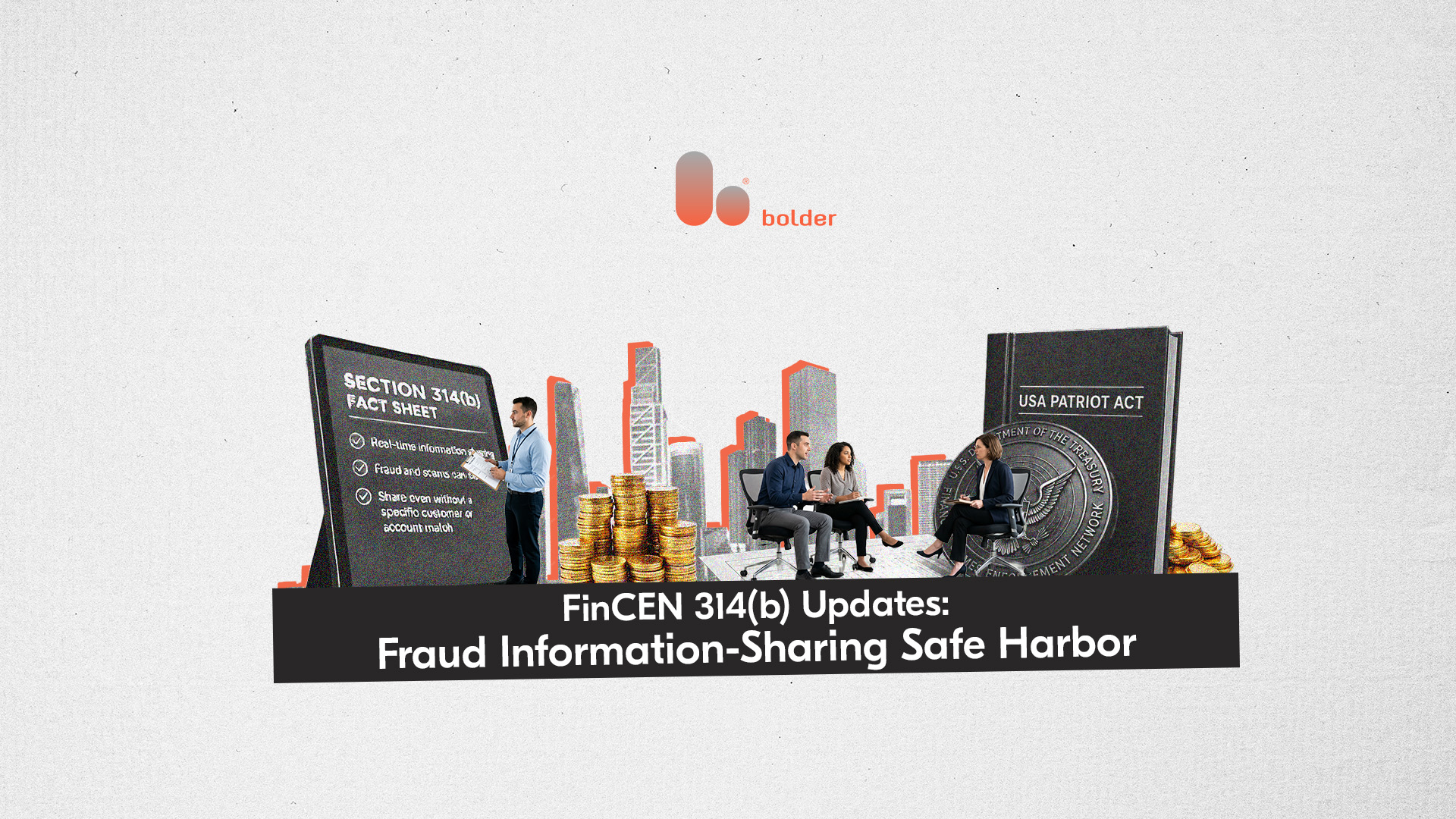
No Proceeds Proof Required: Safe harbor protections no longer require institutions to trace specific laundered funds; it now applies based on suspected fraud alone.
Real-Time Sharing Approved: Institutions can exchange data across verbal, written or electronic channels to intercept active fraud.
Expanded Data Scope: Safe harbor coverage extends to include technical indicators, such as IP addresses, device IDs, transaction records and video surveillance footage.
Can financial institutions share suspected fraud data under 314(b)?
FinCEN’s updated guidance clarifies that financial institutions can rely on the Section 314(b) safe harbor to exchange information regarding suspected fraud. Legally, fraud offenses serve as Specified Unlawful Activities (SUAs) that predicate money laundering, bringing them squarely within the safe harbor.
As a result, safe harbor protections cover a complex fraud typology, including wire fraud, cyber-scams, “pig butchering” schemes and suspicious mule network activity.
Importantly, the Bank Secrecy Act (BSA) rules impose no restrictions on exchanging personally identifiable information (PII), provided the exchange complies with 314(b) requirements. Moreover, institutions may share information with a registered counterparty even if they don’t maintain a direct customer relationship.
How does the expanded 314(b) safe harbor impact compliance operations?
The expansion of the 314(b) safe harbor introduces significant operational requirements for internal compliance teams. Organisations must promptly update their internal data privacy policies, conduct staff retraining on SAR confidentiality protocols and implement verification of counterparty registration status.
Although the authorisation to exchange fraud intelligence is a major advancement for risk management, effective execution relies on robust operational oversight:
Modernising Data-Sharing Agreements (DSAs)
Traditional compliance frameworks often restrict customer data sharing due to conservative legal standards. To align with FinCEN’s expanded guidance, compliance teams need to update Data-Sharing Agreements (DSAs) that authorise the exchange of cyber‑related intelligence and real‑time transaction data.
Disaggregating Suspicious Activity Reports (SARs) from Factual Data
While safe harbor permits the exchange of transactional facts, sharing a Suspicious Activity Report (SAR) remains strictly prohibited by law. To mitigate this risk, teams must implement clear protocols that require analysts to strip all SAR references before transmitting information to counterparties.
Continuous Counterparty Verification
Exchanging data under the 314(b) safe harbor is permissible solely with another registered 314(b) participant. Given the annual renewal requirement, embedding real-time validation checks to confirm a counterparty’s active status is essential before transmitting sensitive data.
Aligning 314(b) with Business Sustainability
Non-compliance under these evolving standards not only invites regulatory scrutiny but also exposes funds, directorships and institutional clients to significant legal and financial risk.
Business sustainability requires independent oversight and a governance framework capable of supporting real‑time data sharing without compromising operational integrity.
Bolder Group: Your Compliance Partner
Keeping internal compliance frameworks aligned with shifting FinCEN standards requires significant time and specialised expertise. The challenge lies in navigating the complexities of expanded 314(b) safe harbor rules, cross-border jurisdictional constraints and internal governance frameworks.
Relying on experts like Bolder Group reduces administrative burdens and minimises the risk of regulatory penalties. Our dedicated governance and compliance professionals seamlessly integrate as an extension of your internal team to help you fortify your risk management framework and manage the intricacies of regulatory updates and data-sharing protocols.
Let’s keep your operations agile, compliant and protected. Learn more about our Governance Solutions or contact your usual Bolder representatives today.