The Cyprus IP Box Regime: A Competitive EU Tax Hub for Tech & Innovation
SEPTEMBER 16, 2026
The Cyprus IP Box Regime: A Competitive EU Tax Hub for Tech & Innovation
Executive Summary
Cyprus offers one of Europe’s most attractive, OECD-compliant intellectual property tax regimes. It provides a compelling base for technology, software and innovation-driven businesses by offering the following advantages:
80% Tax Exemption: Qualifying income derived from eligible intellectual property assets receives an 80% tax exemption.
~3% Effective Tax Rate: When applying the 80% exemption alongside the standard 15% corporate rate, the effective tax rate drops to as low as 3% on qualifying profits.
OECD & EU Compliant: The regime is fully aligned with the OECD Nexus Approach and BEPS Action 5 requirements.
Strategic EU Jurisdiction: Businesses benefit from Cyprus’s robust legal framework, extensive double tax treaty network and access to EU tax directives.
How is the Cyprus IP Box Tax Rate Calculated?
The Cyprus IP Box Regime follows the OECD Nexus Approach, which links the available tax benefit to the level of qualifying research and development expenditure incurred in generating the intellectual property. In general, the greater the proportion of qualifying expenditure, the greater the proportion of IP income that may benefit from the regime.
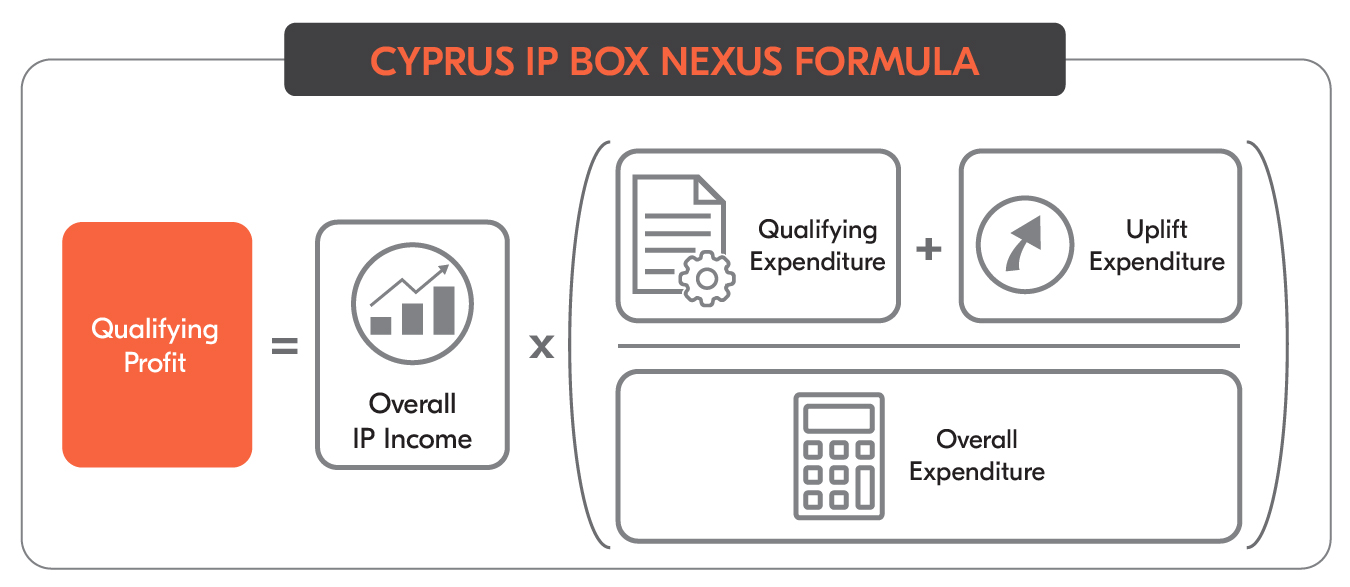
The resulting qualifying profit benefits from an 80% exemption. Where the nexus ratio is 100%, the remaining 20% is subject to Cyprus corporate income tax at 15%, producing an effective tax rate of approximately 3%.
5 Steps to Calculate Your IP Box Tax Exemption
Determine the overall income generated from the qualifying IP asset.
Calculate the nexus ratio by comparing qualifying expenditure, including any permitted uplift, with overall expenditure.
Apply the nexus ratio to overall IP income to determine qualifying profit.
Apply the 80% exemption to the qualifying profit.
Tax the remaining 20% at the applicable Cyprus corporate income tax rate.
What Expenses Qualify Under the Cyprus IP Box Regime?
The nexus ratio generally benefits from expenditure directly incurred by the taxpayer in developing qualifying intellectual property, including:
In-house research and development costs
Employee costs directly related to R&D activities
Direct research and development expenses
Outsourced R&D activities performed by unrelated parties
Which Expenses Reduce the Nexus Ratio?
Certain expenditure is generally included in overall expenditure but not in qualifying expenditure and may therefore reduce the nexus ratio, including:
The acquisition cost of intellectual property
R&D outsourced to related parties
Which IP Assets Qualify for Cyprus Tax Exemptions?
The regime applies to qualifying intellectual property assets that meet the applicable legal and nexus requirements, including:
Patents and patentable inventions
Copyrighted software, including qualifying SaaS-related software IP
Utility models
Plant variety rights and qualifying genetic material protections
Orphan drug designations and supplementary protection certificates
Other legally protected IP that meets the applicable statutory criteria
Non-Qualifying Marketing Intangibles
Marketing-related intangible assets generally do not qualify, including trademarks, brands, logos, customer lists, domain names, goodwill and similar marketing rights.
What Are the Economic Substance Requirements in Cyprus?
Businesses seeking to benefit from the regime should demonstrate genuine economic substance, beneficial ownership and effective control over the development and exploitation of their intellectual property.
Cyprus-resident directors exercising genuine decision-making authority
Regular board meetings held in Cyprus
Qualified personnel involved in the development, management or commercialisation of the IP
Appropriate office premises and operational presence in Cyprus
Local accounting records, contracts and banking arrangements
Documented R&D activities and asset-by-asset nexus tracking
Demonstrable control over the development, enhancement, maintenance, protection and exploitation of the IP
Substance requirements should be assessed according to the activities, risks and scale of each business. Strong substance supports both access to the regime and the wider tax and commercial position of the structure.
Tax Benefits for Cyprus IP Holding Companies
A Cyprus IP holding or operating company may also benefit from EU directives and Cyprus domestic tax provisions, subject to the relevant conditions, beneficial ownership requirements and anti-abuse rules.
EU Parent-Subsidiary Directive: may eliminate withholding tax on qualifying dividends between EU group companies.
EU Interest and Royalties Directive: may eliminate withholding tax on qualifying interest and royalty flows between associated EU companies.
Outbound payments: Cyprus generally does not impose withholding tax on dividends and most interest and royalty payments to non-residents, subject to applicable exceptions.
Treaty and participation benefits: Cyprus offers an extensive double tax treaty network and participation exemption provisions for qualifying dividend income.
Why Choose Cyprus for Your Intellectual Property?
Cyprus combines a competitive IP regime with the advantages of a stable EU jurisdiction, including legal certainty, treaty access, a skilled professional services sector and a cost-effective operating environment. For businesses focused on software development, technology and innovation, Cyprus can provide a practical platform for international growth and IP commercialisation.
Important: Eligibility and the effective tax outcome depend on the specific assets, nexus calculation, ownership structure, substance, transfer pricing and supporting documentation.
Cyprus IP Box vs. Other European IP Regimes
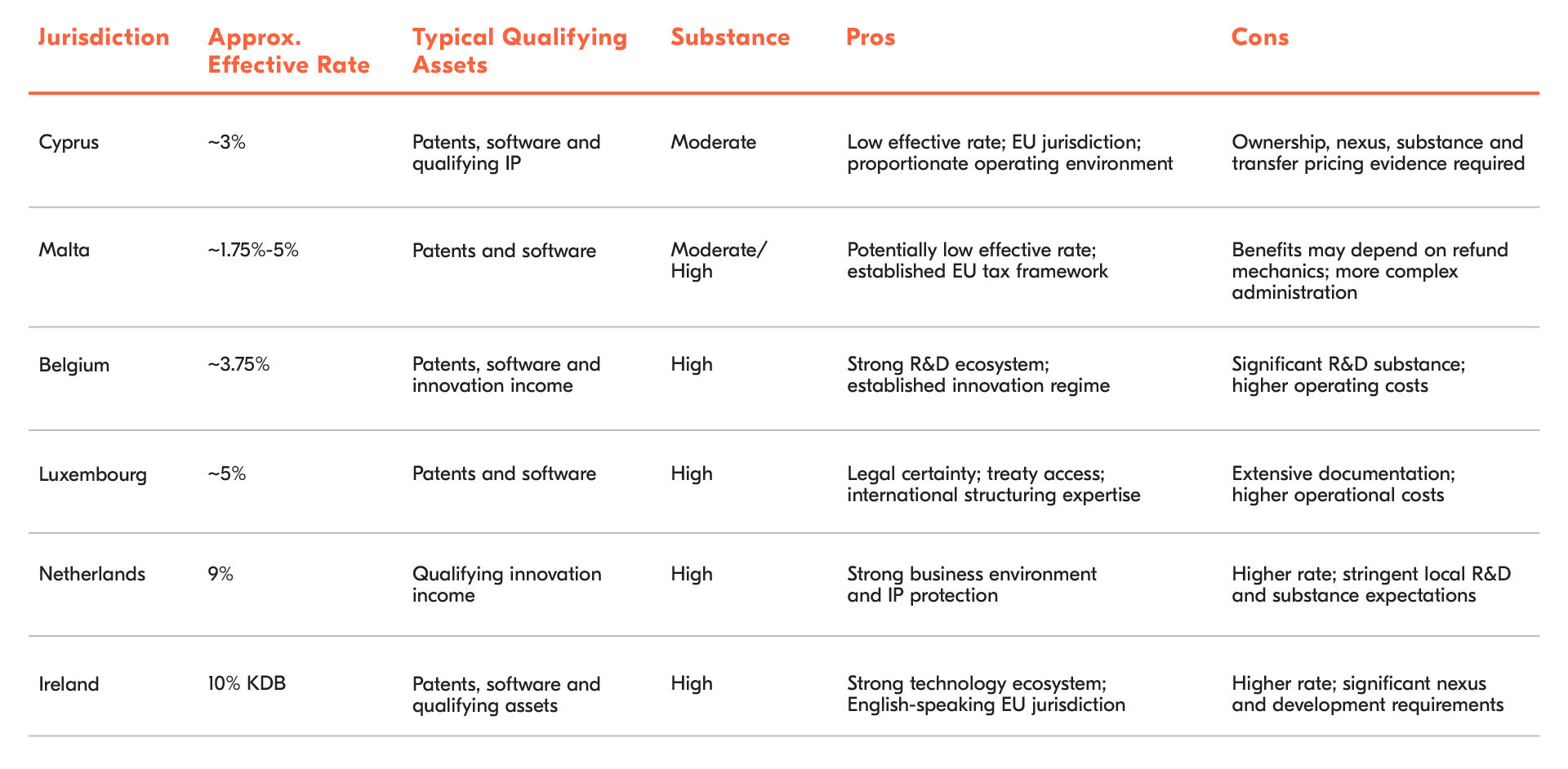
The table below provides a high-level, indicative comparison. The applicable tax treatment and qualifying conditions should be confirmed for each case.
Summary: The Cyprus Advantage for IP Assets
Cyprus combines a low indicative effective rate with EU status and comparatively proportionate substance requirements.
Belgium and Luxembourg offer established regimes but generally require greater substance, documentation and operating costs.
The Netherlands and Ireland may be particularly relevant where substantial local R&D operations are planned.
Malta may offer a low effective rate, although the mechanics and administration can be more complex.
Note: Rates are indicative and may change. The effective outcome depends on the facts, qualifying expenditure, nexus calculation and applicable domestic law.
Contact Bolder Cyprus to Optimise Your Intellectual Property Tax Strategy
If you are considering establishing an intellectual property structure in Cyprus or would like to assess whether your existing IP assets may qualify under the Cyprus IP Box Regime, our specialists would be pleased to assist.
Bolder Cyprus can support you with structure design, substance requirements, tax analysis, implementation and ongoing compliance, helping to align your IP arrangements with your commercial objectives and applicable international standards.
Andreas Liassides
General Manager
Bolder Cyprus
Please contact Andreas Liassides to discuss how Cyprus may support your intellectual property, technology and international growth strategy.
Disclaimer
This resource is intended for general information only and does not constitute legal, tax or investment advice. Professional advice should be obtained before implementing any structure or transaction.